

News & Event
Our group developed to three factories, which is specialized in producing PVC PANEL, PVC FILM and WPC.
Installation Guide: Best Practices for PVC Panel Systems
Editor:Haowang Plastic Co.,Ltd. │ Release Time:2026-02-25
PVC panel systems have become a widely adopted wall and ceiling solution in residential, commercial, and light industrial environments. Their popularity is driven by moisture resistance, ease of cleaning, lightweight construction, and long-term durability. However, achieving optimal performance depends not only on material quality but also on proper installation methods. A well-installed PVC panel system ensures structural stability, visual alignment, and resistance to deformation over time.
This guide outlines technical best practices for installing pvc panel systems, focusing on preparation, structural support, fixing methods, and common issues to avoid.
Understanding the Importance of Proper Installation
A pvc panel is a thermoplastic product with excellent water resistance and dimensional stability. However, like all polymer-based materials, it expands and contracts slightly with temperature variations. Improper fixing, lack of expansion allowance, or uneven structural support can result in warping, buckling, or joint separation.
Correct installation ensures:
Even load distribution across the wall surface
Controlled thermal expansion movement
Strong adhesion or secure mechanical fixing
Long-term aesthetic consistency
When properly installed, a pvc panel system can maintain its shape and performance for many years with minimal maintenance.
Pre-Installation Preparation
1. Substrate Inspection
Before installing any pvc panel, the wall or ceiling substrate must be evaluated. The surface should be:
Structurally stable and free of loose particles
Dry and protected from active moisture infiltration
Reasonably flat to prevent stress concentration
Uneven surfaces should be corrected before installation. While pvc panel systems can conceal minor imperfections, significant irregularities may cause alignment issues.
2. Environmental Conditions
PVC material performs best when installed in moderate temperature conditions. It is recommended to store the pvc panel in the installation area for at least 24 hours prior to fixing. This acclimatization process allows the panels to adjust to ambient temperature and humidity, reducing post-installation dimensional movement.
Avoid installing pvc panel systems under extreme heat or direct sunlight during construction, as temporary expansion may affect alignment accuracy.
3. Tools and Accessories
A complete pvc panel installation typically requires:
Metal or treated wooden battens
Stainless steel screws or concealed clips
Expansion anchors (if fixing to concrete)
Corner trims and finishing profiles
Leveling tools (laser level or spirit level)
Cutting tools suitable for plastic materials
Using corrosion-resistant fasteners is especially important in humid environments.
Structural Framework Design
1. Batten Selection
The supporting structure behind the pvc panel plays a critical role in system stability.
Metal battens are recommended in high-moisture areas such as bathrooms, kitchens, and basements due to their dimensional stability and resistance to rot.
Treated timber battens may be used in dry interior spaces, provided they are straight, dry, and securely fixed.
2. Batten Spacing
Proper spacing ensures that each pvc panel is adequately supported. Standard batten spacing typically ranges between 300 mm and 400 mm center-to-center. Closer spacing improves rigidity and reduces vibration or flexing, particularly for ceiling applications.
Battens must be installed level and aligned vertically or horizontally depending on panel orientation. Precision at this stage prevents cumulative alignment errors during panel installation.
Installation Procedure
1. Establishing the Starting Line
The first pvc panel determines the alignment of the entire wall. Use a level to mark a straight baseline. Any deviation in the initial panel will amplify across the installation.
Allow a small expansion gap (approximately 3–5 mm) at perimeter edges, especially where the pvc panel meets corners or ceilings.
2. Fixing Methods
PVC panel systems can be fixed using:
Concealed clip systems
Screws placed in panel grooves
Adhesive (only when the substrate is smooth and stable)
Mechanical fixing is generally preferred for durability. Screws should not be over-tightened, as this restricts natural expansion and may cause stress marks.
3. Joint and Seam Control
Consistent seam alignment improves both appearance and structural performance. Panels should be connected firmly but not forced together. Overly tight installation can restrict movement and cause surface distortion.
For larger wall areas, consider staggered joint layouts to distribute structural stress evenly.
4. Corner and Edge Treatment
Corner profiles, edge trims, and finishing strips protect exposed pvc panel edges and enhance overall aesthetics. These accessories also conceal expansion gaps while allowing necessary movement.
Proper corner installation is particularly important in wet areas to prevent water from penetrating behind the panel system.
Installation in Different Environments
1. High-Moisture Areas
In bathrooms, kitchens, and laundry rooms:
Use metal battens
Ensure proper ventilation behind panels
Seal perimeter edges appropriately
While pvc panel materials are water-resistant, the structural wall behind them must remain dry.
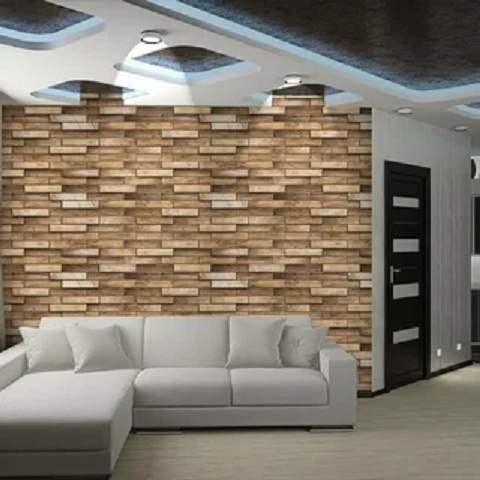
2. Living and Commercial Spaces
In living rooms, offices, and retail environments, focus on:
Perfect vertical alignment
Smooth transitions between panels
Integration with lighting fixtures
Commercial areas may require stronger mechanical fixing due to higher impact risk.
Common Installation Mistakes
Even high-quality pvc panel systems can fail if installed incorrectly. Common errors include:
Excessive batten spacing leading to panel flexing
No expansion allowance at edges
Misaligned starting panel
Over-tightened screws restricting movement
Inadequate moisture control behind panels
Avoiding these mistakes significantly extends the lifespan of the installation.
Final Inspection and Maintenance
After installation, verify:
Alignment and flatness
Secure fixing
Uniform seams
Surface condition
Maintenance of pvc panel systems is minimal. Routine cleaning with mild detergent and a soft cloth is sufficient. Avoid abrasive cleaning tools that could scratch the surface.
A pvc panel system is more than a decorative wall covering—it is a technical assembly that must accommodate structural loads, environmental variation, and daily use. Proper planning, correct batten spacing, controlled fixing pressure, and adequate expansion gaps are essential to achieving long-term performance.
When installed according to best practices, pvc panel solutions provide durable, moisture-resistant, and visually consistent finishes suitable for a wide range of interior applications. The quality of installation ultimately determines whether the pvc panel system performs at its full potential.